Arabic Mehndi Designs: Styles, Patterns & How to Choose the Right One
Arabic mehndi is loved for its flowing lines, bold flowers and clever use of empty space. This practical guide explains the main pattern families, where each style works best, how to choose for Eid, weddings or everyday wear, and what to show your artist before the cone touches your hand.
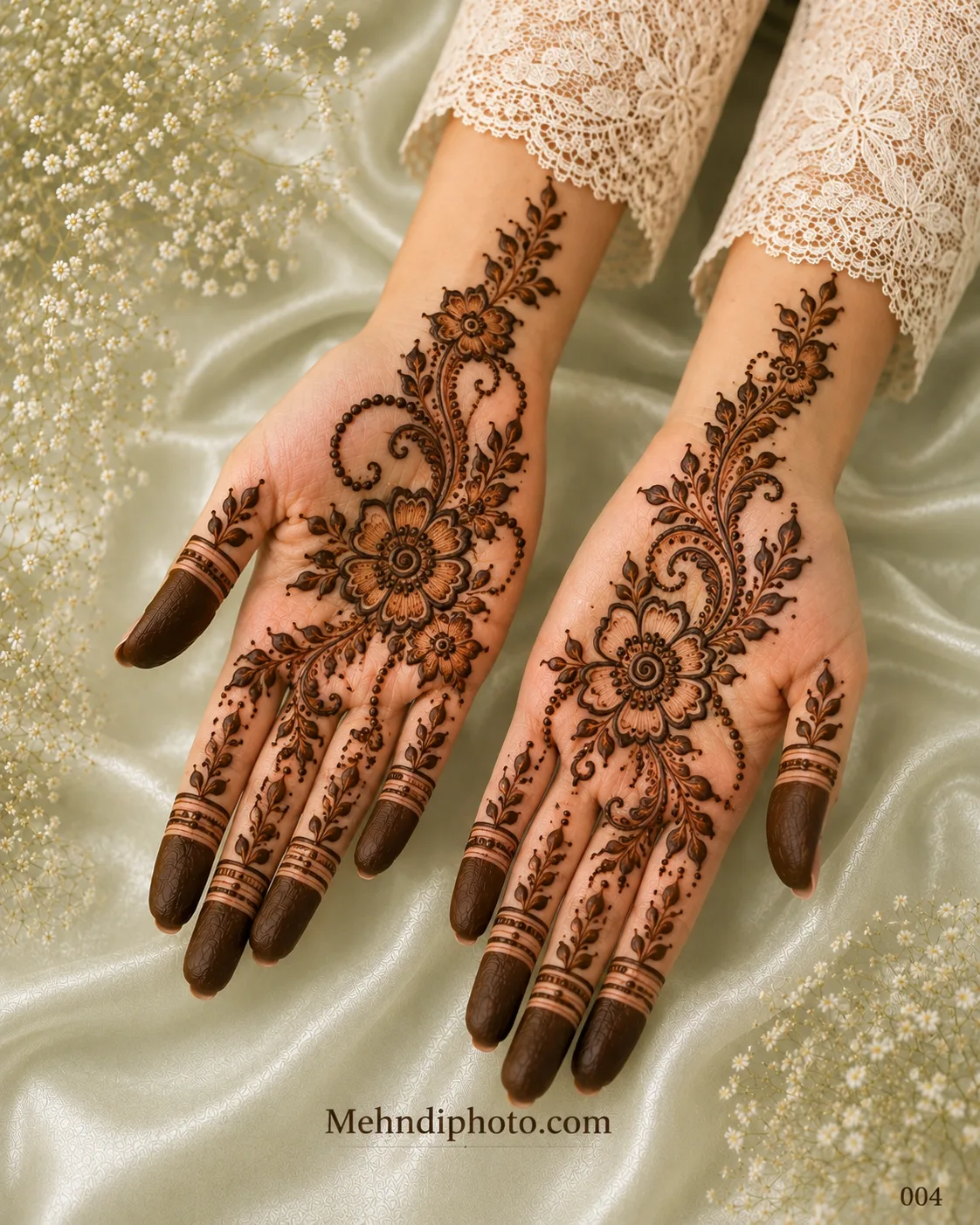
Arabic mehndi has a very particular kind of confidence. It does not try to cover every centimetre of skin. Instead, one strong flower, a curved paisley, a trail of leaves or a clean finger pattern is given enough space to be noticed. That balance between detail and bare skin is what makes the style look light even when the motifs themselves are bold.
If you are choosing a design for Eid, a wedding function, an engagement or simply because you want something elegant without sitting for hours, Arabic mehndi is one of the most flexible options. But “Arabic” is not one single pattern. Some designs are floral and airy, some are dense and jewellery-like, while others mix Gulf-style flow with Indian jaali, mandala or filled-finger details.
This guide is about understanding those differences so you can choose a design that actually suits your hand, outfit, occasion and available time.
What makes a mehndi design look Arabic?
The easiest way to recognise an Arabic-style design is by its movement. The pattern usually travels across the hand instead of filling it evenly from edge to edge. A vine may begin at the wrist, curve through the palm and finish on one finger. On the back hand, a floral trail may run diagonally from the little-finger side towards the wrist.
Four features appear again and again:
- Bold anchor motifs. Large flowers, paisleys, leaves or curved petals usually form the visual centre.
- Negative space. Bare skin is intentionally left between motifs so each part remains readable.
- Flowing direction. The design follows a diagonal, S-curve or vine-like path rather than a strict grid.
- Mixed line weight. Thick outlines sit beside fine filler lines, dots and shading, which gives depth without making the hand look crowded.
That last point is important. Arabic mehndi often looks “simple” from a distance, but a good design still has structure. If every line has the same thickness and every gap is filled, the result quickly loses the open, graceful character that makes the style attractive.
Floral Arabic mehndi: the most versatile choice
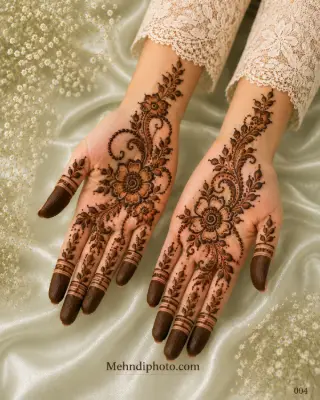
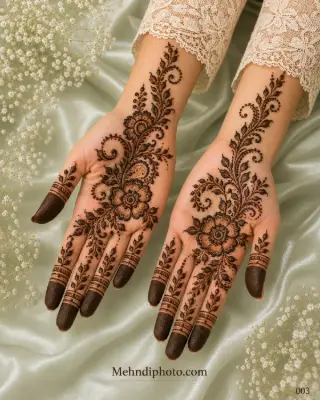
Flowers are the workhorse of Arabic mehndi because they can be scaled up or down without changing the basic flow. A single five- or six-petal flower can sit in the centre of the palm, near the wrist or on the back of the hand. Smaller buds and leaves then carry the eye towards the fingers.
For a light design, one large flower with a leafy trail is enough. For a richer wedding look, the artist can add shaded petals, layered outlines, small paisleys and a second flower near the forearm. The design still feels open as long as there is clear skin between the main sections.
Floral trails are especially useful when you want a design that photographs well from a distance. Tiny details can disappear in full-length pictures, but a strong flower and vine still read clearly when your hands are holding a clutch, dupatta or phone.
Paisley and leaf patterns
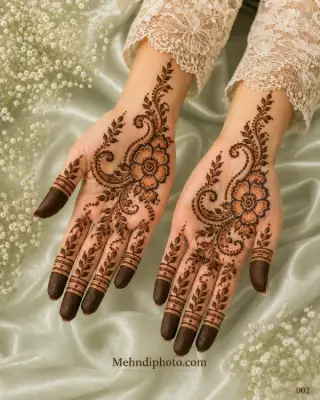
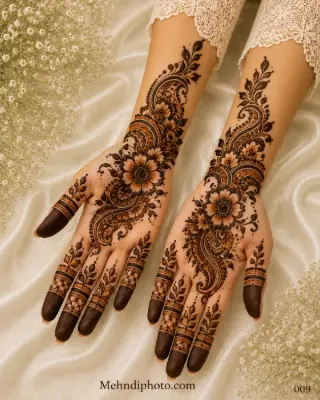
Paisleys add a more traditional feel without making the design heavy. They work best when used as part of the flow rather than repeated everywhere. One large paisley can connect a wrist motif to a flower, while smaller paisleys can fill awkward gaps around the thumb or side of the palm.
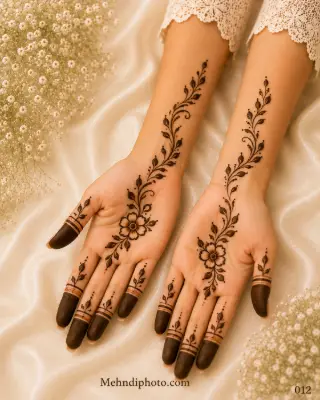
Leaf patterns are lighter. Repeated leaves on a curved stem create movement and are forgiving if you are learning to apply mehndi yourself. They also suit narrow hands because the vertical direction can visually lengthen the design without covering the whole palm.
A useful rule: if the main flower is already detailed, keep the leaves simple. If the flower is plain, the leaves can carry more line work. Giving every motif equal complexity usually makes the design look busy.
Jaali, grids and Indo-Arabic fusion
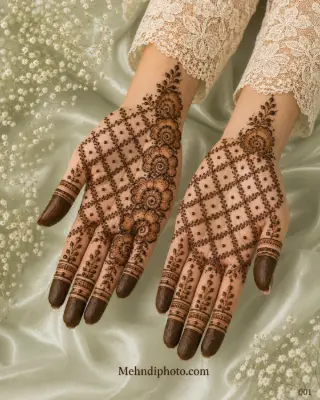
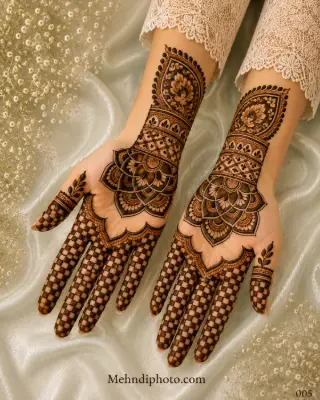
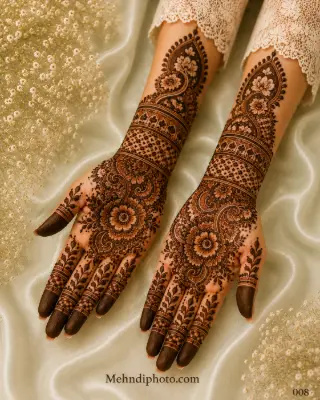
Purely open floral work is not the only option. Many modern designs combine Arabic flow with Indian-style jaali, checks, scallops or mandala fragments. This is often called Indo-Arabic mehndi.
The fusion works because the two styles solve different problems. The Arabic structure gives the design direction; the Indian fillers add richness where you want more detail. For example, a broad flower can lead into a small jaali panel near the wrist, while the rest of the hand stays open.
This approach is useful for engagement and wedding guests who want something more dressed-up than a simple vine but do not want full bridal coverage. It also pairs well with heavily embroidered outfits because the design has enough detail to hold its own without competing with the clothes.
Front hand or back hand: where does Arabic mehndi work best?
Arabic mehndi works on both sides, but the composition should change.
On the front hand, the palm gives the artist a wider canvas. Designs can begin with a flower or paisley in the lower palm and move diagonally towards the index or middle finger. The thumb side is a good place for small leaves or dots that balance the composition without closing the open spaces.
On the back hand, the bones and tendons create natural lines. A diagonal vine, bracelet-style wrist band or one strong motif below the knuckles usually looks more elegant than trying to fill the entire surface. Finger detailing matters more here because the fingers remain visible in almost every hand pose.
If you are unsure, think about how the hand will be seen. Palm designs look beautiful in posed photographs where both hands face the camera. Back-hand designs are more visible while holding a bag, exchanging rings, serving food or simply moving around at an event.
How to choose finger patterns
Finger work can completely change the mood of an Arabic design. The safest mistake to avoid is decorating all five fingers heavily when the palm itself is very open. That creates a top-heavy look.
For a modern result, try one of these combinations:
- Two detailed fingers, three lightly dotted or banded fingers.
- Thin leaf trails on all fingers with empty gaps around the joints.
- Filled fingertips only when the rest of the design has enough weight to balance them.
- Ring-style bands on the back hand for engagement or party looks.
- A single vine continuing onto the index finger while the remaining fingers stay minimal.
Shorter fingers usually look cleaner with smaller motifs and less solid filling. Longer fingers can carry wider bands and more layered patterns without feeling crowded. Browse dedicated finger mehndi designs if this is the part you want to plan first.
Arabic mehndi for Eid
Arabic designs are especially practical for Eid because they can look festive without requiring a long bridal-style sitting. On Chand Raat, time is often limited and several family members may be waiting for the same artist. A flowing floral trail, bold back-hand vine or wrist-to-finger pattern gives a finished look relatively quickly.
For Eid outfits with heavy sleeves or bangles, keep the mehndi concentrated on the hand and fingers so the design remains visible. With simpler clothes, extending a vine a little past the wrist can make the overall look feel more dressed up.
Crescent-like curves, leafy trails and fine dots can suggest a festive mood without turning the design into a literal themed illustration. The strongest Arabic designs usually rely on good composition rather than adding too many symbols.
For weddings, engagements and parties
A wedding guest rarely needs the same level of coverage as the bride. Arabic mehndi is ideal here because the design can be scaled according to your role and schedule.
For a close family wedding, choose a fuller pattern with two or three connected motifs, a detailed wrist and coordinated fingers. For a reception or sangeet, a bold back-hand trail can be enough. For an engagement, leave some breathing room around the ring finger so jewellery does not get visually lost.
Brides can use Arabic elements too, particularly for a lighter bridal aesthetic. A bride who dislikes very dense traditional coverage might choose broad floral trails on the back hands and more detailed work on the palms. The key is coordination: both hands should look like part of the same design language even if the coverage differs. Compare options in the bridal mehndi collection.
How to match Arabic mehndi with jewellery and sleeves
Before choosing a reference image, look at what you will actually be wearing. Mehndi and jewellery share the same small visual space, so they can either support or compete with each other.
If you are wearing a large hathphool, keep the centre of the back hand comparatively open. Let the mehndi frame the jewellery instead of sitting directly underneath every chain and stone. With stacked bangles, finish the design just below the wrist or create a clean wrist border so the transition looks intentional.
For full sleeves, hand-focused designs make more sense because forearm work will stay hidden. With sleeveless, short-sleeved or three-quarter outfits, a longer vine can extend towards the forearm and still be visible.
The same principle applies to nail colour. Dark, highly decorated nails already add visual weight at the fingertips. In that case, lighter finger mehndi often creates better balance than fully packed finger caps.
How much coverage is enough?
There is no correct percentage of skin that an Arabic design must cover. The right amount depends on how formal the occasion is and how much detail you personally enjoy.
Minimal coverage works for college events, casual festivals and people trying mehndi for the first time. Medium coverage suits Eid, engagements, family weddings and parties. Fuller Arabic or Indo-Arabic work can suit bridesmaids, close family members and brides who prefer open patterns over traditional dense mehndi.
Instead of asking an artist for “50 percent coverage,” show a reference and point out the exact things you like: the size of the main flower, how much empty space you want, whether fingers should be filled, and where the design should stop on the arm. Visual instructions are much clearer than percentages.
What to check before showing a reference to your artist
A beautiful photo is not automatically the right reference for your own hand. Before saving it, check five things.
- Count the major motifs. If there are three large flowers on a very long hand and your palm is smaller, the artist may need to remove one rather than squeeze everything together.
- Look at the finger length and spacing. Designs made for long, slim fingers often need simplification on shorter fingers.
- Check where the pattern ends. If your sleeves begin at the wrist, an elaborate forearm section may be wasted.
- Notice whether the image shows one hand or both. If you want coordinated hands, ask the artist how the second hand will relate to the first rather than assuming it will be copied exactly.
- Decide which parts are non-negotiable. Perhaps you love the flower but not the filled fingertips. Tell the artist that before application starts.
Common mistakes that make Arabic mehndi look messy
The most common problem is overfilling. Empty space is not unfinished space in Arabic mehndi; it is part of the design. Filling every gap with dots, leaves and tiny lines removes contrast.
Another mistake is using too many focal points. One large flower, one secondary motif and a clear trail usually look stronger than four unrelated flowers competing across the palm.
Poor line hierarchy is another issue. Thick outlines should define the main shapes, while finer lines should handle details. If everything is equally bold, the design looks flat.
Finally, do not force symmetry when the composition is meant to flow. Two hands can coordinate without being mirror copies. Repeating the same flower family, line weight and finger treatment is often enough to make them feel like a pair.
Can beginners try Arabic mehndi at home?
Yes. In fact, the style is beginner-friendly when you choose the right pattern. Start with leaves, teardrops, simple petals, dots and one curved line. These shapes can be repeated into a vine without requiring perfect geometry.
Practice the main flower on paper first, then rehearse the direction of the trail. When applying on skin, draw the large shapes before the fillers. This prevents you from spending ten minutes on tiny details only to realise the overall composition is drifting in the wrong direction.
A beginner should also resist cutting the cone tip too wide. Bold Arabic lines do not mean uncontrolled thick lines. You still need a clean edge, especially around petals and paisleys. For simpler references, browse easy mehndi designs.
Choosing a design that still feels like you
Trends change quickly. One season everyone wants oversized roses; another season it is bracelet mehndi, shaded lotus patterns or clean finger bands. A good reference should fit your taste even after the trend moves on.
If you normally prefer minimal jewellery and simple clothes, an extremely dense design may feel unlike you no matter how impressive it looks online. If you enjoy ornate outfits and detailed accessories, a tiny wrist vine may feel underdone. Use trends as inspiration, not as instructions.
The easiest place to start is the Arabic Mehndi gallery on MehndiPhotos. Compare a few floral, paisley and jaali-based designs side by side, then save the ones whose spacing and coverage you actually like. You can also compare Front Hand Mehndi, Back Hand Mehndi, Easy Mehndi and Bridal Mehndi collections before deciding how light or detailed you want the final look.
Frequently asked questions
Is Arabic mehndi always simple?
No. The style often uses more empty space than traditional Indian mehndi, but it can still be highly detailed. A full Indo-Arabic design may include shaded flowers, jaali panels, layered paisleys and complex finger work while keeping open gaps between sections.
Does Arabic mehndi suit small hands?
Yes. Use fewer, smaller anchor motifs and keep the flow narrow. One flower with a vertical or diagonal trail usually suits a small hand better than several large motifs squeezed together.
Which is better for Eid: front-hand or back-hand Arabic mehndi?
Both work. Back-hand designs are highly visible during everyday movement and pair well with jewellery, while palm designs give a richer traditional feel in posed photographs. Many people choose a fuller front hand and a lighter back hand, or the reverse, depending on the outfit.
Can Arabic mehndi be used for a bride?
Absolutely. A bride can choose full Arabic coverage or combine Arabic flow with Indian detailing. The important part is making the front hand, back hand and forearm feel coordinated rather than selecting unrelated references for each area.
Should both hands have exactly the same design?
Not necessarily. Matching motifs and similar coverage can look more natural than strict mirror copies. One hand can carry the main flower while the other uses a related paisley or vine, as long as the line style and spacing are consistent.
Final thought
The appeal of Arabic mehndi is not simply that it is quick or fashionable. Its real strength is control: you can decide exactly where the eye should go and exactly how much skin should remain visible. A well-placed flower, a confident vine and clean negative space can look more polished than a hand filled with dozens of motifs.
Choose the flow first, then the details. Match the coverage to the occasion, leave room for jewellery, and show your artist a reference that fits the shape of your own hand. That is usually the difference between a design that only looks good in someone else's photo and one that feels right when it is finally on you.