Engagement Mehndi Designs: Elegant Ideas for Your Ring Ceremony
Engagement mehndi usually needs a different balance from full bridal henna: enough detail to feel special, but enough open space for rings, bangles and close-up photographs to stand out. This guide covers front and back hand ideas, coverage levels, personalized motifs, jewellery-friendly placement, design styles and practical planning tips for an elegant ring ceremony look.
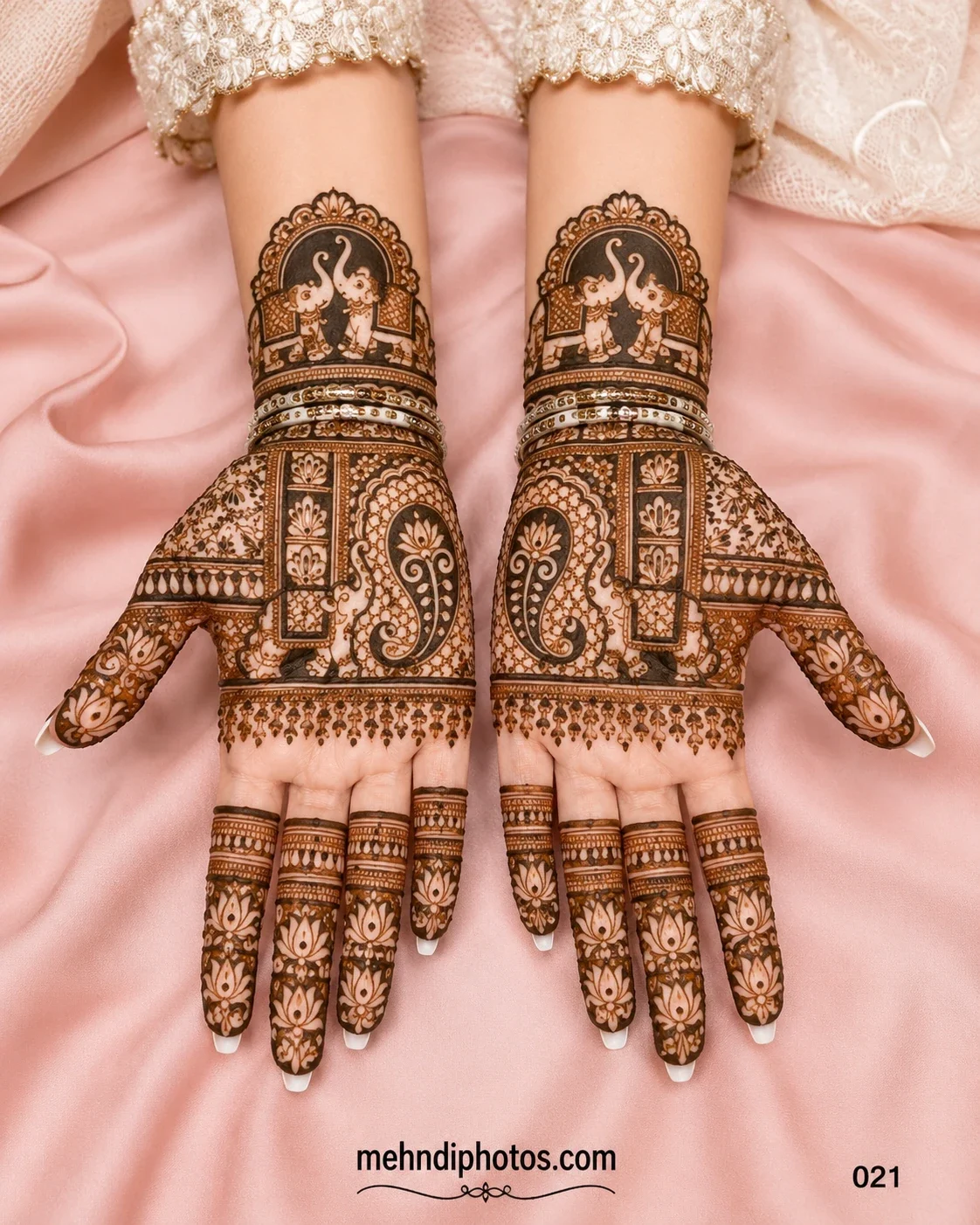
Engagement mehndi sits in a sweet spot between everyday henna and full bridal work. It should feel special enough for a major celebration, but it does not have to cover every inch of the hands. For many brides-to-be, the best engagement design is the one that photographs beautifully with the ring, suits the outfit and jewellery, and still feels comfortable for the pace of the event.
That is why choosing an engagement design is less about finding the most detailed reference and more about finding the right coverage, placement and visual balance. A clean floral trail with open skin can look more polished in a ring close-up than a very dense pattern. On the other hand, a traditional full-hand design can be perfect if the ceremony is formal and the outfit is heavily embellished.
This guide explains the main engagement mehndi designs to consider, how front-hand and back-hand placement changes the look, which motifs work well with rings and bangles, and how to plan a design that feels personal without becoming overcrowded.
How is engagement mehndi different from bridal mehndi?
There is no strict rule that separates engagement mehndi from bridal mehndi. The difference is usually in the level of coverage and the purpose of the design.
Bridal mehndi often extends farther up the arms and uses dense storytelling, traditional fillers or highly detailed symmetry. Engagement mehndi is often lighter. It may stop at the wrist or lower forearm, leave more negative space, and give jewellery a bigger role in the overall look.
If your engagement and wedding are close together, you may also prefer a design that feels distinct from the bridal mehndi you plan to wear later. Choosing a modern floral, Arabic-inspired or jewellery-style engagement design can help the two events look different in photographs.
Choose the coverage before choosing the pattern
One of the easiest ways to narrow down references is to decide how much hand coverage you actually want.
Minimal engagement mehndi
Minimal designs are ideal when you want the ring, manicure and jewellery to remain visually prominent. A small back-hand motif, a delicate wrist band, a leafy finger trail or a side-palm flower can be enough.
This level of coverage is useful for a modern ring ceremony, a small family engagement, or anyone who prefers clean styling over traditional full-hand henna.
Medium coverage
Medium coverage is one of the most versatile choices. The design can cover most of the palm or back of the hand while leaving clear areas of skin around the fingers, wrist or central motifs.
Florals, jaali sections, paisleys and mandala elements work especially well at this level because they create visible detail without making the hand feel too busy.
Full-hand engagement mehndi
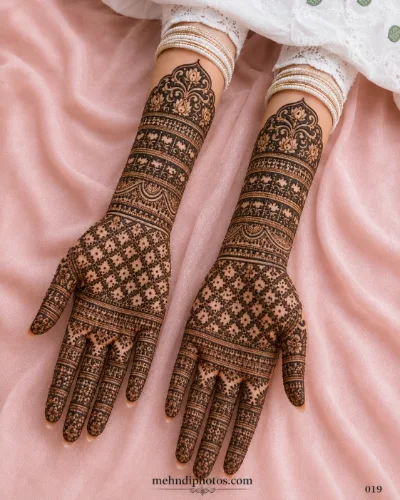
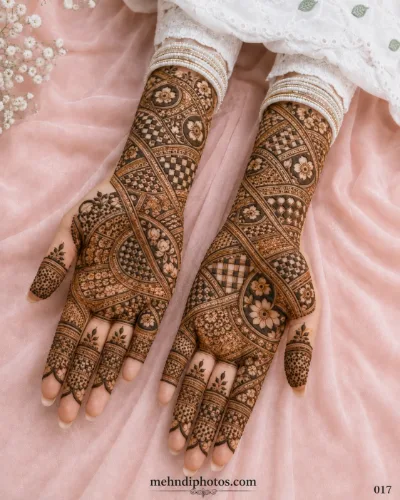
Full-hand designs work well for formal engagements, elaborate outfits and families that prefer a more traditional look. The design can extend from fingertips to the lower forearm while still using slightly more open spacing than dense bridal henna.
If you choose full coverage, make sure the ring finger and the area around important jewellery do not disappear inside very fine detail. A good artist can keep the design rich while still creating one or two visual focal points.
Front hand engagement mehndi ideas
The palm gives more room for large motifs, names, initials and symmetrical compositions. It also appears frequently in posed photographs where the bride shows both hands together.
Floral and paisley compositions
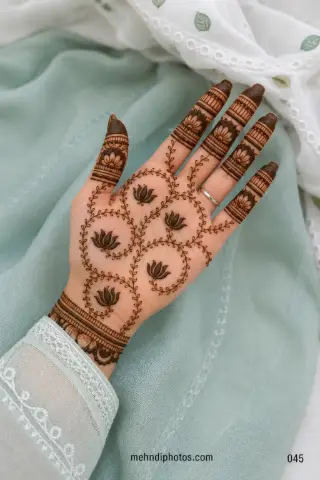
Flowers and paisleys are reliable because they can be scaled to suit almost any hand. One large floral motif can anchor the palm, with leaves and curved paisleys extending toward the fingers and wrist.
For a lighter look, keep the centre flower open and use smaller details only around the edges. For fuller coverage, connect the floral section to wrist bands or jaali panels.
Mandala-style palms
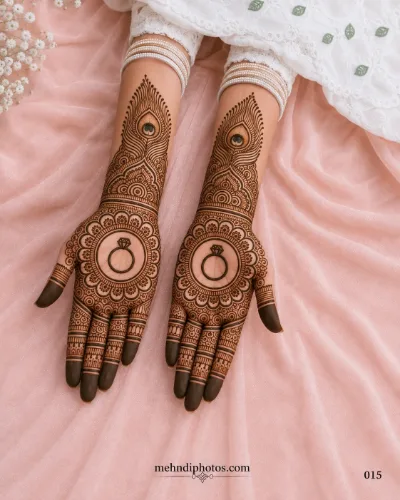
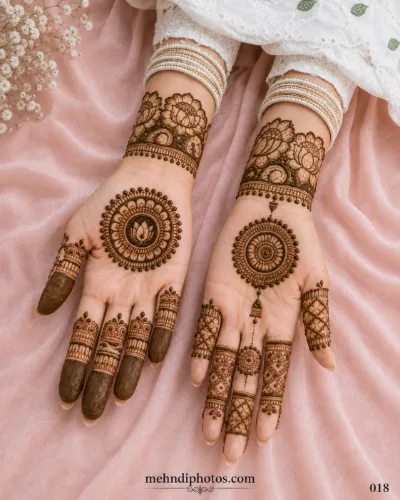
A centred circular motif gives the palm a clear focal point and works well when you want symmetry without filling the whole hand. A mandala can be paired with simple fingertips, thin wrist detailing or small motifs on the outer palm.
If you like this structure, compare it with the gol tikki mehndi collection before deciding how traditional or modern you want the centre motif to feel.
Personalized initials
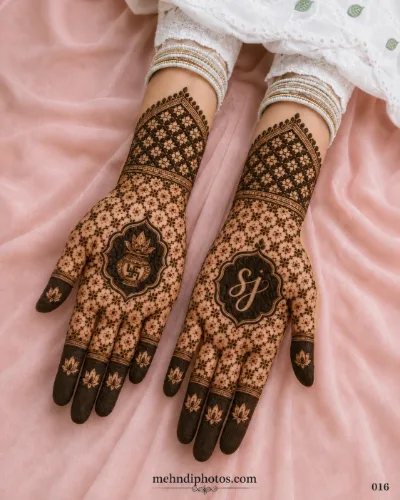
Initials are popular for engagements because they can make the design feel specific to the couple without requiring an elaborate portrait or story scene. They can be hidden inside a flower, placed within a small frame, or worked into a wrist motif.
Keep the lettering simple enough to remain readable after the paste is removed. A tiny decorative monogram can lose clarity if it is surrounded by equally fine detail.
For more placement references, browse the front hand mehndi gallery.
Back hand engagement mehndi ideas
The back of the hand matters especially for an engagement because this is often the side shown when the ring is photographed. The best pattern should frame the jewellery rather than compete with it.
Ring-focused designs
A ring-focused layout can keep the area immediately around the engagement ring relatively open while placing detail along the side of the finger, across the hand or near the wrist. This gives the ring breathing room in close-up photographs.
Another option is to use a delicate trail that begins at the wrist and ends below the ring finger. The visual line naturally leads the eye toward the jewellery.
Bracelet and chain mehndi
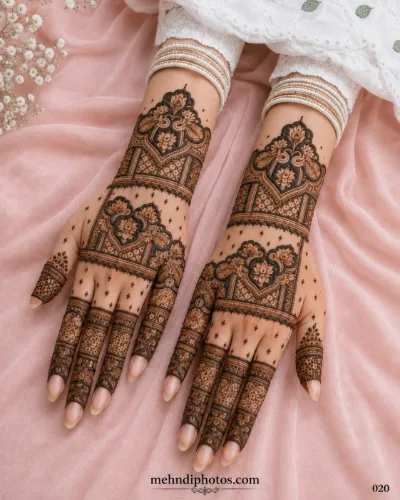
Jewellery-style mehndi works beautifully on the back hand. A wrist cuff connected to one or two fingers by thin chains, dots or leafy trails can look elegant without requiring heavy coverage.
This style is particularly useful if you plan to wear several bangles because the mehndi can visually continue the jewellery rather than sit underneath it as a separate dense block.
Floral jaali designs
A small jaali section combined with flowers can give the back hand a traditional feel while still leaving skin visible. Keep the grid neat and avoid extending it into every finger unless you want a fuller look.
See the back hand mehndi gallery for different ways artists balance open space around rings and knuckles.
Should the ring finger have more or less mehndi?
There are two good approaches, and they create very different photographs.
Leave the ring finger lighter if you want the ring to be the strongest detail. A thin border, small dots or one leafy element can be enough.
Decorate the ring finger intentionally if you want the mehndi to frame the jewellery. Use a narrow band, a vertical vine or a motif that stops before the ring. The key is to avoid random dense filling directly around the stone or setting.
If the ring has a wide band or a large setting, try it on while choosing references. A design that looks spacious on a bare finger may feel crowded once the jewellery is added.
Popular styles for engagement mehndi
Modern floral mehndi
Large flowers, leaves and open skin create a soft contemporary look. This style works well with pastel outfits, light jewellery and daytime ceremonies.
Arabic-inspired mehndi
Arabic-inspired patterns use bold florals, flowing vines and deliberate negative space. They are useful when you want the design to feel noticeable from a distance without covering the entire hand. Browse the Arabic mehndi collection if you prefer this flowing structure.
Traditional Indian mehndi
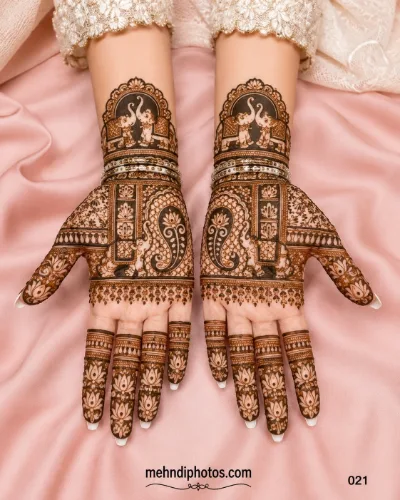
Paisleys, lotus motifs, jaali sections, symmetrical borders and fine fillers create a richer traditional appearance. This style suits heavily embroidered lehengas, sarees and formal family ceremonies.
Jewellery-style mehndi
Bracelet cuffs, chain motifs, finger rings and hanging details can imitate hand jewellery. This style naturally complements an engagement because the mehndi and the actual ring become part of the same visual story.
Minimal finger mehndi
If you want most of the hand clean, decorate only two or three fingers with bands, leaves or small geometric sections. This gives enough detail for close-up photographs while keeping the look modern. The finger mehndi gallery has useful references for this kind of placement.
How to match mehndi with your engagement outfit
You do not need to copy the embroidery from your outfit into the mehndi. It is usually better to borrow one visual idea and repeat it subtly.
If the outfit has large floral embroidery, one or two larger flowers in the mehndi can create a connection. If the outfit is geometric, a clean jaali or check pattern can echo that structure. If the clothing is already very ornate, simpler mehndi may prevent the overall look from becoming visually heavy.
Also consider sleeve length. If your sleeves cover most of the forearm, detailed mehndi high above the wrist may not be visible. In that situation, spend the detail budget on the hands and fingers instead.
Planning around rings, bangles and nail colour
Engagement photographs bring several details into the same frame: the ring, nails, mehndi, bangles and sleeves. The design should leave enough separation for each element to be visible.
If you are wearing statement rings, keep nearby mehndi slightly cleaner. If your bangles are heavy, finish the henna with a simple wrist border rather than an equally heavy cuff. If your nails use detailed nail art, very dense fingertip mehndi can make the upper part of the hand look crowded.
This does not mean everything has to be minimal. It means one element should lead while the others support it.
Both hands: identical or coordinated?
Exact mirror designs can look formal and polished, but they are not the only option. Coordinated hands often feel more natural.
You can use the same flower, border style and finger treatment on both hands while changing the central motif. One palm could feature a mandala while the other includes initials or a larger paisley. The two hands still look related because the visual language is consistent.
For back hands, matching wrist bands with slightly different floral trails can create the same effect.
Personalized engagement mehndi ideas that stay elegant
Personalization works best when it feels integrated rather than added at the last minute.
- Hide both initials inside a floral or paisley motif.
- Add the engagement date in a small frame near the wrist.
- Use a tiny ring or proposal-inspired icon as a secondary detail.
- Repeat a flower or motif that appears in the engagement decor.
- Use one meaningful symbol on one palm and a complementary motif on the other.
Do not add every idea at once. One or two personal elements are usually enough to make the design memorable.
What photographs well at an engagement?
Close-up ring photographs reward clear composition. Large readable motifs, clean edges and visible skin gaps tend to remain recognisable when the image is viewed on a phone screen.
Very tiny detail can look impressive in person but merge into texture in wider photographs. If photography matters to you, ask for at least one strong focal motif on each hand.
Back-hand poses usually show the ring most clearly, while palm-facing poses show the mehndi itself. Planning both sides with different photo purposes can produce a more varied engagement album.
How long before the ceremony should you apply engagement mehndi?
Plan enough time that you are not rushing from the mehndi chair directly into dressing and jewellery. The exact schedule depends on your event, the amount of coverage and the henna you are using, so follow the advice of your artist for their paste and process.
From a practical point of view, complete tasks that involve frequent hand washing, skincare or styling before the application when possible. Wear something comfortable while the paste is on, and avoid sleeves or jewellery that may rub against fresh lines.
Simple aftercare habits
Good henna needs time to develop its colour. Freshly removed paste usually looks lighter and deepens afterward. Exact stain results vary with henna quality, skin and aftercare.
- Start with clean, dry hands before application.
- Avoid lotion immediately before the artist begins.
- Let the paste dry without rubbing the design.
- Keep it on for the duration recommended by your artist.
- Avoid unnecessary water exposure immediately after removing the paste.
- Do not judge the final colour the moment the paste comes off.
Common engagement mehndi mistakes
Choosing a bridal-level design without enough time
A rushed full-hand pattern can look less polished than a medium-coverage design completed carefully. Match the reference to the actual time available.
Ignoring the engagement ring
If the ring is central to the event, choose the back-hand placement with the ring on or at least keep its size in mind. Jewellery can cover motifs that looked important in the reference.
Using too many unrelated motifs
Lotus flowers, portraits, elephants, jaali, Arabic vines, mandalas and initials can all work—but not necessarily in the same design. Choose a small visual vocabulary and repeat it consistently.
Filling every empty space
Negative space is useful. It separates motifs, highlights jewellery and helps the design remain clear in photographs.
Copying a reference without adapting it to the hand
Finger length, palm width and wrist shape vary. A good engagement design should be adjusted to the actual hand instead of forcing every motif into the same proportions as the reference photo.
A practical checklist before you finalize the design
- Decide minimal, medium or full coverage first.
- Choose whether the ring or the mehndi should be the main back-hand focus.
- Save separate front-hand and back-hand references if needed.
- Check how far your sleeves and bangles will cover the design.
- Pick two or three main motifs instead of mixing every style.
- Decide whether you want initials, a date or no personalization.
- Keep at least one clear focal area for photographs.
- Confirm how far the design should extend beyond the wrist.
Final thoughts
The best engagement mehndi is not automatically the heaviest one. It is the design that makes sense with your ring, outfit, jewellery, ceremony and personal style. A delicate back-hand trail can be perfect for one bride-to-be, while another may feel most like herself with symmetrical full-hand florals and traditional jaali work.
Start by deciding coverage, then choose the main style and only after that add personal details. This order keeps the design coherent and makes it easier to explain exactly what you want to your artist.
Browse the Engagement Mehndi collection and save a few references that match your preferred coverage. Compare the front, back and finger placement rather than focusing on one beautiful motif in isolation. That small amount of planning can make the final mehndi feel far more intentional—and much easier to photograph with your ring.