Finger Mehndi Designs: Simple, Stylish & Bridal Ideas
Finger mehndi is perfect when you want a design that feels finished without covering the whole hand. This practical guide explains simple finger bands, floral and leafy patterns, front- and back-hand placement, ring-friendly ideas, bridal options, symmetry tips and ways to choose a design that suits your fingers and occasion.
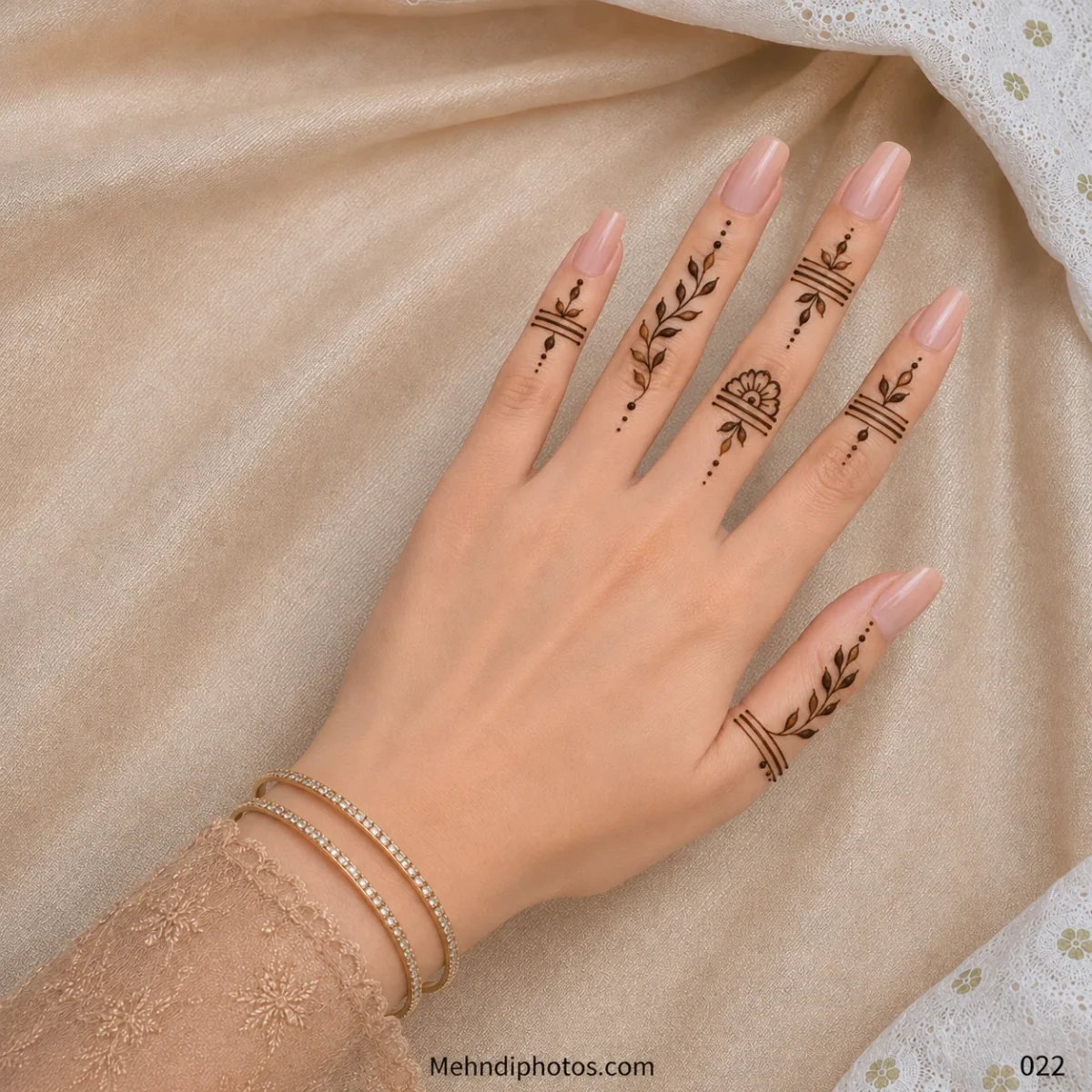
Finger mehndi is one of the easiest ways to make a hand look dressed up without committing to a full palm or full-arm design. A few clean bands, a leafy trail or a small floral pattern can work for a festival, an engagement, a wedding function or even an ordinary day when you want something light.
The small area is also what makes finger mehndi tricky. There is less room to hide uneven spacing, and repeated patterns can expose small differences quickly. The best finger designs are not necessarily the most detailed. They are the ones that fit the finger shape, leave enough breathing space and still look balanced when the hand is relaxed.
This guide covers the main types of finger mehndi designs, how front- and back-hand placement changes the look, which patterns work with rings, and how to avoid the common mistakes that make a simple design look crowded.
Why finger mehndi works so well
Finger mehndi gives you flexibility. You can decorate all five fingers, only two or three, or use the finger pattern as a finishing detail for a larger hand design. It also works across very different styles, from minimal leafy bands to dense bridal panels.
Because the design is concentrated in a narrow area, it is usually faster to apply than full-hand mehndi. That makes it useful for Eid, Diwali, Teej, Karwa Chauth, engagement functions, wedding guest looks and last-minute family events.
It also pairs naturally with jewellery. Rings, bangles and bracelets already create visual detail, so the mehndi does not need to fill every gap.
Popular types of finger mehndi designs
1. Simple finger bands
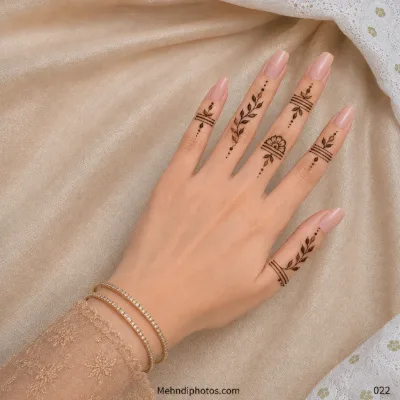
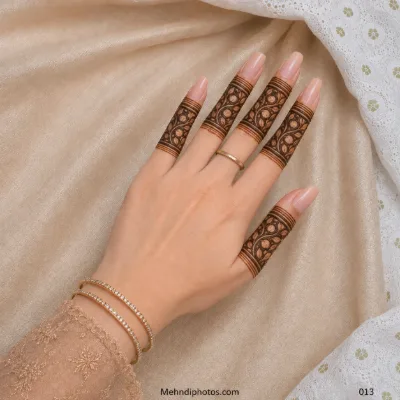
Finger bands are one of the most practical styles. They can look like tiny rings made from lines, dots, leaves or scallops. You can place one band near the middle joint, stack two small bands, or repeat a similar pattern on several fingers.
If you are applying mehndi yourself, do not make every band too narrow. Slightly wider bands are easier to control and remain visible after the stain develops.
2. Leafy finger mehndi
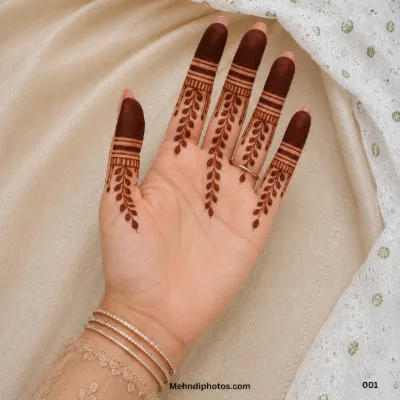
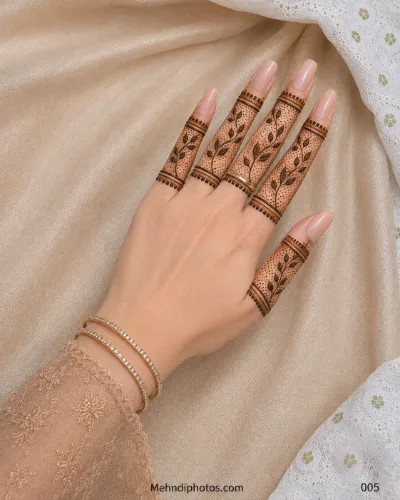
A small vine running along one side of the finger creates movement without making the design heavy. Leaves are forgiving because they do not need perfect symmetry. They can also be adapted to short, medium or long fingers simply by changing the number of leaves.
Leafy patterns are especially effective on the back of the hand, where the design can continue naturally toward the knuckles or wrist.
3. Floral finger designs
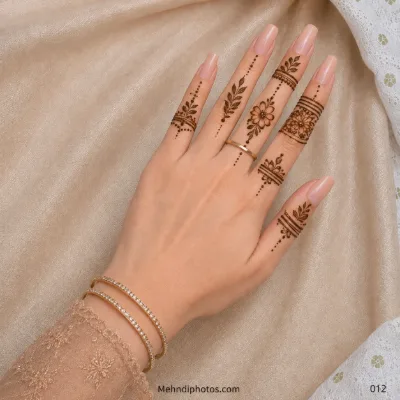
Flowers can be used as a small motif near the knuckle, a half-flower at the base of the finger or a repeated petal band. One larger flower usually looks cleaner than several tiny flowers squeezed into the same space.
For a coordinated hand, repeat one petal shape across two or three fingers rather than copying the entire pattern exactly.
4. Geometric finger mehndi
Lines, checks, triangles, diamonds and small jaali sections create a modern, structured look. Geometric designs can be striking, but they require consistent spacing. If you are a beginner, use one geometric section as an accent instead of building the whole finger from tiny repeated grids.
5. Filled fingertip designs
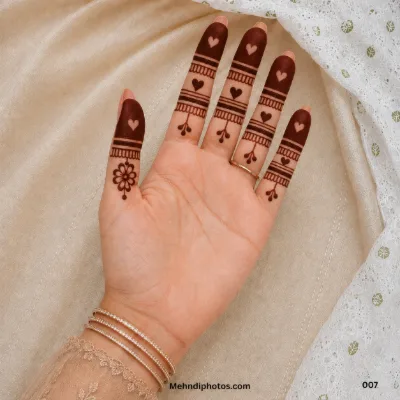
Dark fingertips are a traditional choice and create strong contrast. They can be paired with light finger bands or a central palm design. If every fingertip is filled, keeping the rest of the finger simpler usually prevents the hand from looking too heavy.
6. Jewellery-style finger mehndi
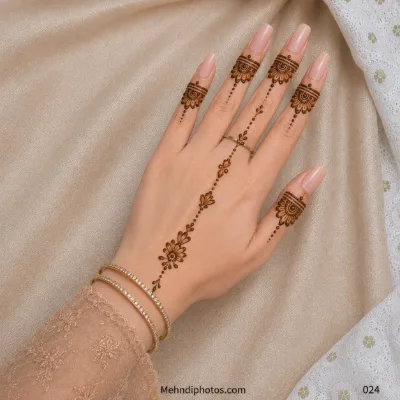
Some designs imitate rings, chains and delicate hand jewellery. A narrow band can connect to a dot trail or leafy line that runs toward the back of the hand. This style works particularly well for engagements because it complements the ring instead of competing with it.
Front-hand finger mehndi ideas
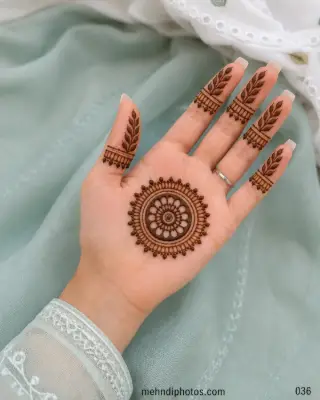
On the palm side, the fingers naturally connect to whatever is happening in the centre of the hand. If the palm has a mandala or floral motif, the finger details should support it rather than introduce a completely unrelated style.
For a minimal front-hand look, decorate only the upper half of the fingers and leave the palm open. Another easy structure is to use short bands near the joints and add one small motif at the centre of the palm.
If you want more coverage, alternate patterns rather than repeating the same design on all five fingers. For example, use floral bands on the index and ring fingers, lighter lines on the middle and little finger, and a simple leaf trail on the thumb.
Browse the front hand mehndi collection to compare how finger details are balanced with larger palm patterns.
Back-hand finger mehndi ideas
The back of the hand is ideal for finger-focused mehndi because the design remains visible while holding a phone, posing for photos or showing jewellery. Finger bands, leafy trails and bracelet-style patterns all work well here.
A popular layout is to give every finger a small coordinated band and connect only one or two fingers to a larger motif on the hand. This keeps the design cohesive without filling the entire surface.
Another option is a diagonal composition: a vine begins near the wrist, crosses the hand and visually continues into one finger while the remaining fingers carry simpler bands.
See the back hand mehndi gallery for examples of how open space can make finger patterns stand out more clearly.
Should all five fingers have the same design?
They can, but they do not need to. In fact, perfectly repeated finger patterns are often harder to execute because tiny differences in spacing become obvious when the fingers are placed side by side.
A coordinated set is usually more forgiving. You might use the same border style on three fingers, a leafy variation on one and a slightly bolder panel on another. The hand still feels intentional because the line weight and motif family are consistent.
If you prefer symmetry, keep the overall height of the finger designs similar even when the internal details vary.
Finger mehndi for short fingers
Short fingers usually look better with vertical movement and moderate spacing. Very wide horizontal bands can visually shorten the fingers further, especially if several are stacked closely together.
Try narrow leafy trails, small V-shaped motifs, light diagonal lines or one band with a little open space above and below it.
Do not assume you need tiny motifs because the finger is short. Tiny detail can make the design look cramped. Fewer, slightly larger elements are often cleaner.
Finger mehndi for long fingers
Longer fingers can carry more detail, but that does not mean the entire length has to be filled. You can use two separated bands, a longer vine or a panel that covers one section while leaving the next joint open.
If every finger is fully covered, introduce negative space somewhere on the hand so the design still has visual contrast.
Ring-friendly finger mehndi for engagements
For an engagement, the ring is usually the focal point. Mehndi should frame it rather than hide it.
If you know which finger will carry the ring, leave a clean area around the ring position. You can place a small band above it and another below it, or keep the ring finger mostly open while giving the neighbouring fingers more detail.
On the back of the hand, a delicate line or vine running toward the ring finger can guide the eye naturally toward the jewellery.
For more ideas designed around ring ceremony styling, explore the engagement mehndi collection.
Finger mehndi for brides
Bridal finger mehndi is usually denser than everyday finger work, but it still needs structure. Fine jaali, petals, scallops, paisleys and repeated borders are common. The best bridal finger designs usually change rhythm from one section to another instead of using the same tiny filler from base to tip.
If the palm and forearm are already heavily detailed, fingers can use cleaner panels and stronger outlines. This contrast helps the overall bridal design remain readable in photographs.
For full bridal references, compare designs in the bridal mehndi gallery.
Simple finger mehndi for festivals and everyday wear
For a quick festive design, choose one pattern that can be repeated without much measuring. A leafy band, small floral cuff or pair of curved lines with dots can be enough.
You can also decorate only two fingers. The index and little finger create a balanced frame around an open hand, while the ring finger and middle finger create a more central focus.
Minimal finger mehndi works especially well with rings because both elements remain visible.
Arabic-inspired finger mehndi
Arabic mehndi is known for flowing vines, larger florals and generous negative space. On fingers, that style translates well into side vines, curved leaf trails and one or two bold motifs rather than dense filling.
The result feels lighter and more modern than a fully packed traditional finger pattern. If you like this flow, browse the Arabic mehndi designs for references that can be adapted to smaller finger areas.
How to balance finger mehndi with the rest of the hand
Finger designs should feel like part of one composition. If the palm uses thick outlines and large flowers, extremely tiny lace on the fingers may feel disconnected. If the hand is minimal, very dark finger panels can overpower everything else.
Use three things to create consistency:
- Line weight: keep the main strokes similarly bold across the hand.
- Motif family: repeat a leaf, flower, dot or border shape from the main design.
- Spacing: if the palm uses plenty of open skin, leave some open space on the fingers too.
Easy finger mehndi structures for beginners
One-band method
Place one simple band on each finger at roughly the same height. Vary the details slightly if needed, but keep the width consistent. This is faster than building a full vertical pattern.
Alternating fingers
Decorate the index, middle and little finger while keeping the others lighter. This reduces repetition and still makes the hand look complete.
Leaf-trail method
Draw one central or side curve, then add leaves along it. The curve gives you a guide, so you do not need to plan every small detail in advance.
Dot-and-line method
Use two or three clean horizontal lines and finish them with dots or small arches. This is one of the quickest options when time is limited.
Common finger mehndi mistakes
Making every motif too small
Tiny details may look elegant in a zoomed-in reference photo, but they require more cone control. On the hand, slightly larger motifs often look cleaner and stain more clearly.
Crowding the joints
The skin around finger joints folds and moves. Very dense detail placed directly over every joint can lose clarity. Leaving a small break can make the design easier to read and more comfortable while the paste dries.
Repeating a difficult pattern five times
If the first finger is hard to complete neatly, repeating it four more times usually makes the differences more noticeable. Simplify the structure before continuing.
Ignoring finger width
The thumb is wider than the little finger. A motif that fits the thumb may need to be simplified for the little finger rather than squeezed into the same proportions.
Forgetting jewellery placement
If you plan to wear a statement ring, consider it before filling the finger. Mehndi and jewellery should have separate visual space.
How to make finger mehndi look cleaner in photos
Photography often reduces very fine detail. Strong borders, clear negative space and one or two recognisable motifs usually photograph better than a finger covered with tiny fillers from edge to edge.
Moisturise your hands in the days before the event, but avoid oily lotion immediately before the mehndi application. Once the stain has developed, clean nails and simple jewellery can make the finger pattern look more polished in close-up shots.
How dark finger mehndi develops
The final stain depends on henna quality, skin chemistry, application time and aftercare. Finger skin can take colour differently across the hand, especially near fingertips and joints.
Apply mehndi to clean, dry skin. Let the paste dry naturally and keep it on for several hours when practical. After removing the dried paste, avoid immediately soaking the hands. The colour usually deepens over the following hours.
A darker stain can make bold finger bands look especially clear, but a good design should still rely on clean structure rather than colour alone.
How to choose the right finger design for your occasion
Engagement
Choose ring-friendly spacing, light floral bands or jewellery-inspired chains. Keep the ring finger clean enough for the jewellery to remain the focal point.
Eid or festive functions
Leafy trails, floral bands and Arabic-inspired finger patterns are quick, elegant and easy to coordinate with bangles.
Wedding guest
Medium coverage works well. Use a stronger back-hand motif with coordinated fingers, or combine a palm design with lighter finger panels.
Bride
Detailed finger sections can support a full bridal composition, but each finger should still have a clear structure. Dense does not have to mean visually confusing.
Everyday or college
One or two decorated fingers are enough. A small band or leafy line gives a finished look without getting in the way of daily activity.
A practical way to save finger mehndi references
When browsing designs, do not save only the complete hand photo. Zoom in and notice how each finger is built. Look at where the design begins, how much space is left around the joints, whether the pattern is vertical or horizontal, and how the thumb is handled.
Save two or three references rather than ten unrelated ones. One can show the overall style, one can show the finger detail you like, and one can show how the design works with jewellery. This gives your mehndi artist a clearer direction.
Final thoughts
Finger mehndi can be minimal, traditional, modern, Arabic-inspired or bridal. The small canvas makes placement more important than motif count. A clean band with good spacing can look more refined than a dense pattern that has no breathing room.
Choose a style that matches your finger proportions, your jewellery and the occasion. Keep repeated patterns simple enough to stay consistent, and let open skin be part of the design.
Browse the latest finger mehndi designs on MehndiPhotos and compare simple bands, leafy motifs, floral patterns and fuller bridal options before choosing the one that fits your look.