Full Hand Mehndi Designs: Bridal, Arabic & Traditional Ideas
Full hand mehndi can look rich without becoming visually crowded. This guide explains coverage, motif balance, finger planning, bridal layouts and how to choose a design that suits your hand and occasion.
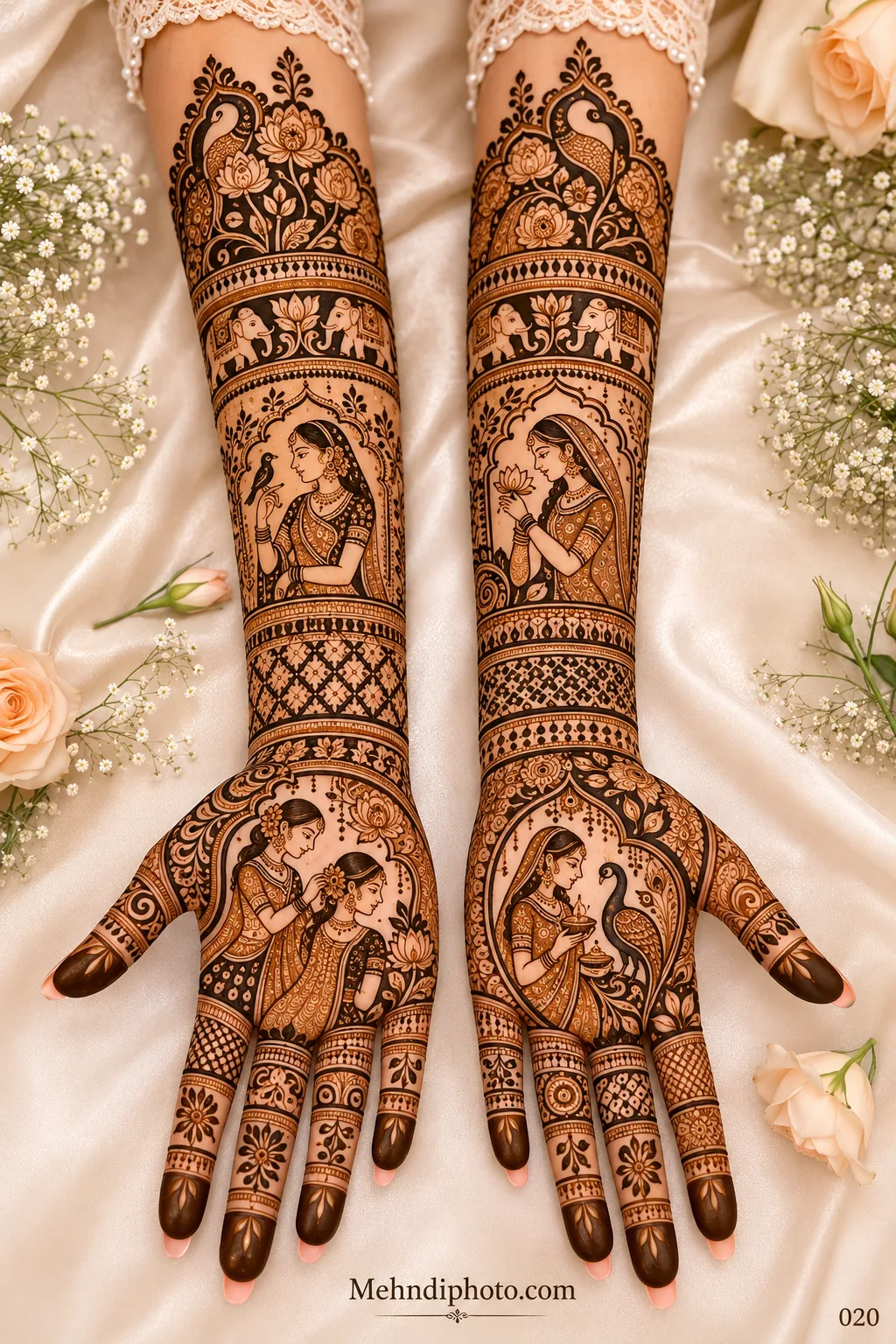
Full hand mehndi is often chosen for weddings, engagements and major festivals because it creates a complete, dressed-up look. But “full hand” does not mean every centimetre has to be filled with the same level of detail. The strongest designs use a clear structure: focal motifs, supporting patterns, planned finger work and enough contrast for the design to remain readable.
What counts as a full hand mehndi design?
For some people, full hand means the palm and fingers. For others, it means coverage from fingertips to the wrist or several inches up the forearm. Decide the endpoint before choosing a reference so the design does not stop awkwardly.
Full hand bridal mehndi
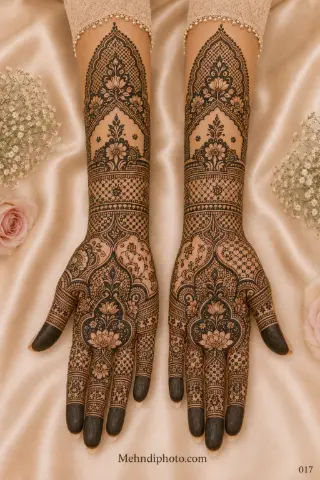
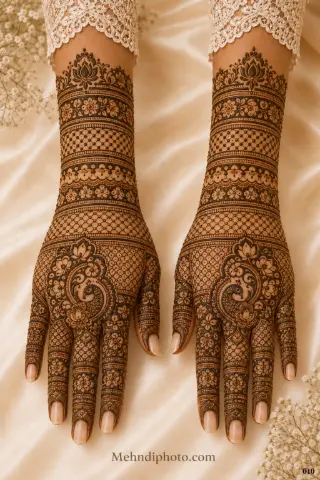
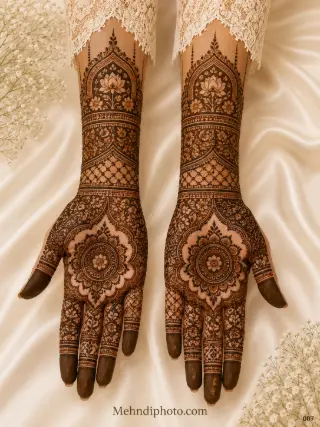
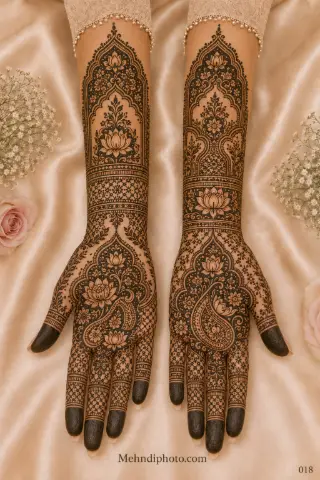
Bridal full-hand designs often combine florals, paisleys, jaali, mandalas, peacocks, architectural arches and personalised motifs. The detail can be dense, but larger focal areas should still be visible from a distance.
Explore Bridal Mehndi Designs for complete wedding references.
Arabic full hand mehndi
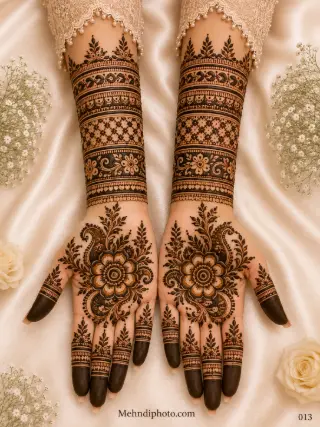
Arabic full-hand mehndi uses larger floral shapes, bold outlines and flowing vines. Even with broad coverage, the design can feel lighter because negative space separates the main elements.
See Arabic Mehndi Designs for open, flowing layouts.
Traditional Indian full hand mehndi
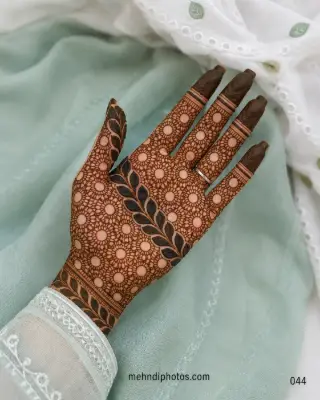
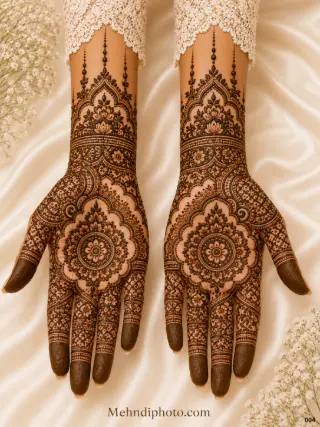
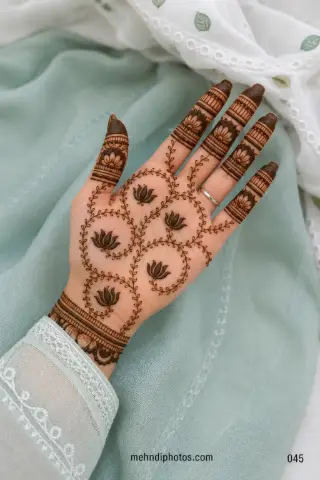
Traditional Indian patterns usually build detail in layers. Paisleys, lotus flowers, fine grids, scalloped borders and repeated motifs can create a rich result when each section has a purpose.
Front hand planning
The palm is the widest area, so it should carry one of the strongest visual ideas. A mandala, large floral centre, portrait or paisley cluster can anchor the design. Smaller fillers should support that focal point rather than competing with it.
Browse Front Hand Mehndi for different palm structures.
Back hand planning
On the back of the hand, the eye naturally follows the fingers and jewellery lines. Bracelet cuffs, diagonal florals, jaali panels and chain-style motifs work well here.
Browse Back Hand Mehndi for back-hand layouts.
Finger design matters more in full coverage
When the palm and wrist are detailed, plain or poorly planned fingers can make the hand feel unfinished. Finger patterns do not all need to match. They simply need a consistent visual language.
- Use repeating bands for a structured look.
- Use alternating floral and geometric sections for variety.
- Leave small negative-space gaps so the fingers do not look too heavy.
- Keep the scale appropriate for finger length.
For focused inspiration, see Finger Mehndi Designs.
How to keep a full hand design from looking crowded
The easiest solution is hierarchy. Choose one or two large motifs, then use medium and small details around them. If every section is equally dense, the design can become visually flat.
Alternating filled areas with open skin or lighter jaali also creates contrast.
Symmetrical vs different designs on both hands
Perfect symmetry gives a formal, traditional appearance, but it takes time and control. Coordinated asymmetry is often more practical: both hands can share the same border, flower type or finger treatment while using different central motifs.
Full hand mehndi for engagement
For engagement photos, consider leaving a little more open space around the ring finger and back of the hand. This keeps the ring visible and prevents jewellery from disappearing into dense detail.
See Engagement Mehndi Designs for ring-friendly references.
How far should the design extend?
A wrist-length design is easier to manage and works for many festivals. Forearm coverage creates a more bridal look. If you extend the design higher, use a gradual finish—smaller motifs, a border or tapering vine—rather than an abrupt cutoff.
Choosing full hand mehndi for your hand shape
Small palms usually benefit from fewer, slightly larger motifs. Long fingers can carry more bands and vertical detailing. Wider palms can support central mandalas and symmetrical layouts comfortably.
Time and comfort
Full-hand mehndi takes longer than minimal designs. Sit in a position that supports your arms, wear clothing that will not touch wet henna and plan enough time for the paste to dry before moving around.
Common mistakes
- Using too many unrelated motif styles.
- Making every detail extremely small.
- Ignoring the transition between palm and wrist.
- Overfilling fingers until the design loses clarity.
- Copying a reference without adapting it to hand size.
Final thoughts
A full hand mehndi design should feel complete, not simply full. Good spacing, strong focal motifs and planned transitions make the design easier to read and more attractive in photographs. Choose your coverage first, then find a reference whose structure fits your hand and occasion.