Mehndi: Its History, Importance, Uses & Beautiful Traditions
From henna leaves to bridal hands — the story of mehndi, how the paste is made, what it means in Indian culture, how traditions differ across countries, and the tips that give you a deep, long-lasting stain.

Few things say celebration in South Asia quite like the cool, earthy smell of fresh mehndi paste on a warm afternoon. Long before the sangeet playlist starts or the wedding lehenga comes out of its box, someone in the family is already soaking henna leaves, kneading paste, or booking an artist. Mehndi is not just decoration — it is memory, ritual and community rolled into one.
This guide walks through what mehndi actually is, how it is made, why it matters so much in Indian culture, how traditions differ across countries, and the practical tips that make the difference between a pale orange smudge and a deep, rich stain you will happily photograph for days.
What is Mehndi?
Mehndi is the art of decorating skin — usually hands and feet — with a paste made from the leaves of the henna plant (Lawsonia inermis). The plant contains a natural dye molecule called lawsone, which binds to the keratin in the outer layer of skin and leaves behind a reddish-brown stain that fades gradually over one to three weeks.
The words mehndi and henna are often used interchangeably. Henna generally refers to the plant and the dye; mehndi usually refers to the tradition and the art form as practised across India, Pakistan, Bangladesh, Nepal and the Middle East. Either way, the material is the same humble shrub that grows happily in hot, dry climates.
What makes mehndi unusual among body arts is that it is temporary but not casual. It costs nothing but time, it hurts no one, and it disappears on its own — yet it is treated with enormous ceremony. That gentle contradiction is part of its charm.
How Mehndi is Made: From Leaves to Paste
Traditional mehndi starts in the garden. Mature henna leaves are harvested, dried in shade so the dye does not degrade, and then ground into a fine powder. Good powder is sifted several times — the finer the powder, the smoother the lines an artist can draw.
To make paste, the powder is mixed with a mildly acidic liquid, most often strong tea or lemon water, and left to rest for six to twelve hours. This resting period is called dye release: the lawsone slowly migrates out of the leaf particles and becomes available to stain skin. A few drops of essential oil such as cajeput, lavender or eucalyptus are usually added, because the natural terpenes in these oils help produce a darker stain.
The finished paste has the consistency of soft toothpaste. It is loaded into a rolled plastic cone, and the artist snips a tiny opening at the tip — the smaller the hole, the finer the detail.
A word of caution that matters more than any design tip: real mehndi is never black. So-called "black henna" cones often contain PPD, a chemical hair dye that can cause chemical burns and permanent scarring. Natural paste is olive-green when wet and stains orange first, then deepens to maroon-brown over two days.
Why Mehndi is Important in Indian Culture
In India, mehndi is considered one of the solah shringar — the sixteen adornments of a bride. It sits alongside bangles, kajal and jewellery as part of what makes a woman look and feel complete on an auspicious day.
Beyond adornment, mehndi carries meaning. It is associated with blessings, prosperity and the good wishes of everyone in the room. Grandmothers still say a bride''s stain will be dark if her mother-in-law loves her dearly — a piece of folklore that has launched a million teasing conversations, and one that quietly encourages brides to keep the paste on longer.
There is also a practical layer. Henna has a cooling effect on the skin and mild antiseptic properties, which mattered a great deal in hot climates and before modern medicine. Applying it to palms and soles was believed to calm the nerves of a bride facing a huge life change.
Mehndi is not reserved for weddings alone. Festivals such as Karwa Chauth, Teej, Diwali, Eid and Raksha Bandhan all bring out the cones, and many families treat a monsoon afternoon as reason enough.
Mehndi in Indian Weddings and the Mehndi Ceremony
The mehndi ceremony is usually held one or two days before the wedding, most often at the bride''s home or a family venue. It is deliberately informal compared with the rituals that follow — bright yellows and greens instead of heavy reds, folk songs instead of formal chants, and food that people eat standing up.
The bride''s hands and feet are covered in the most elaborate work, often taking four to six hours. Traditional bridal mehndi designs tell a story: peacocks, dulha-dulhan figures, temple domes, paisleys, doli scenes and dense jaal patterns that run past the elbow.
A well-loved custom is hiding the groom''s initials somewhere in the design, and asking him to find them later that night. Meanwhile, sisters, cousins and friends queue up for smaller designs on their own hands, and this is where the day''s real laughter lives.
One more tradition worth mentioning: a bride is not expected to do housework until her mehndi fades. It is a small, generous way of giving her a few days of rest.
Mehndi Traditions Around the World
Henna travels well, and every region has shaped it into something of its own.
India
Indian mehndi is famous for density and storytelling. Fine lines, figures, mandalas and full coverage from fingertip to forearm define the classic look. Explore the regional style in the Indian mehndi collection.
Pakistan
Pakistani mehndi sits between Indian detail and Arabic flow — heavy on floral motifs, jaal work and bold shaded centres, often with more open space near the wrist. See examples in the Pakistani mehndi collection.
Bangladesh
Bangladeshi designs lean towards flowing florals and soft, rounded motifs, with beautiful work created for Eid as much as for weddings. Browse the Bangladeshi mehndi collection.
UAE and the Middle East
Gulf and Khaleeji styles favour large, confident flowers, trailing vines and generous negative space. This is where the Arabic mehndi look comes from, and it remains the fastest style to apply and the easiest to wear. Explore more in the Middle East collection.
North Africa and the diaspora
Moroccan and Sudanese henna use bolder geometry and thicker strokes. In the UK, USA, Canada and Australia, mehndi has become a fixture of Eid and Diwali gatherings, and increasingly of festivals and baby showers too — see the American mehndi collection for that fusion feel.
Why Mehndi Designs Matter
Choosing a design is really about matching effort, occasion and the shape of your hand. A few broad families are worth knowing.
- Bridal: dense, symmetrical and narrative, covering hands and forearms. Hours of work, and worth every minute.
- Arabic: flowing floral vines with open space, quick to apply and very forgiving for beginners.
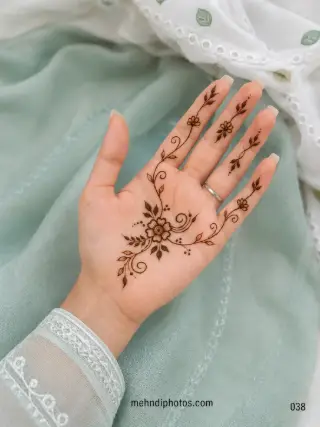
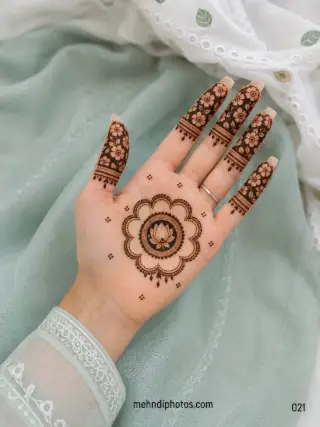
- Simple and minimal: a single vine, a small mandala or a few finger accents — perfect for work, college or a quiet festival at home. See easy mehndi designs.
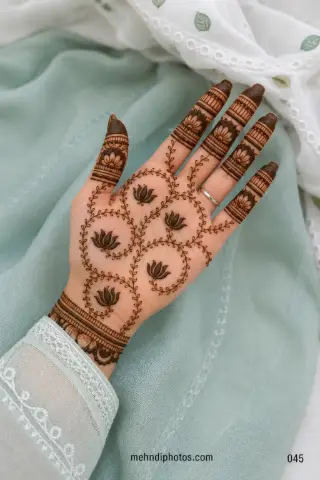
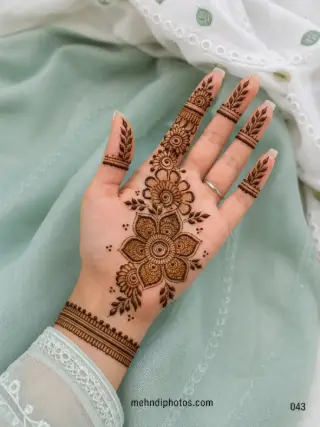
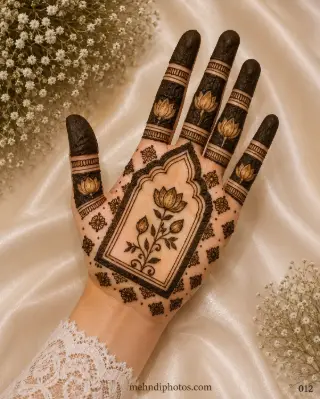
- Front hand: the palm side, traditionally the most detailed because it stains darkest. Browse front hand mehndi designs.
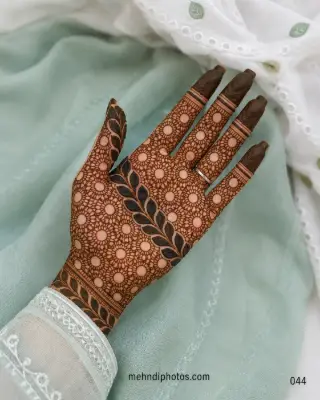
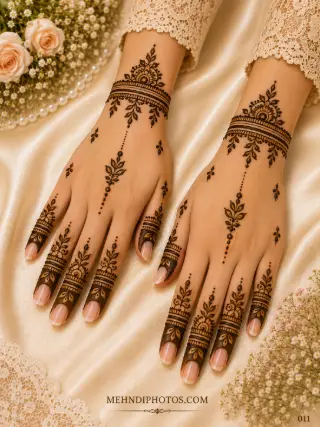
- Back hand: the side everyone actually sees when you gesture, usually built around a central mandala or gol tikki. Browse back hand mehndi designs.
- Feet and legs: anklet-style borders and mirrored motifs that pair with the bridal look. See leg mehndi designs.
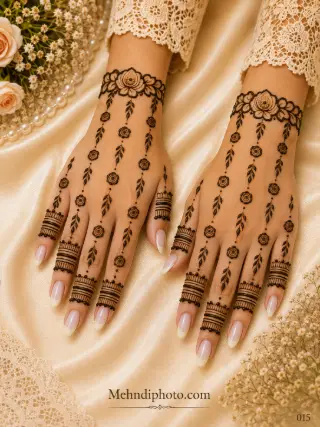
Fingers deserve their own mention — narrow strips, tips and half-finger caps can lift an otherwise simple design instantly, as the finger mehndi designs gallery shows.
Tips Before and After Applying Mehndi
Before
- Wash and exfoliate your hands, then skip lotion, oil and sunscreen — anything greasy blocks the dye.
- Use fresh paste. Cones older than a few days lose strength unless they were frozen.
- Do a small patch test if you have sensitive skin, and never accept a cone that stains jet black in minutes.
- Plan your outfit and jewellery first, then pick a design that suits the sleeve length.
After
- Leave the paste on for at least six hours; overnight is better for a deep bridal stain.
- Dab a lemon-sugar mix lightly on the drying paste to keep it stuck to the skin — do not soak it.
- Keep hands warm. A little heat from a stove, a heater or simply wrapping up deepens the colour.
- Scrape the dry paste off; do not wash it away. Avoid water for the first twelve hours.
- Rub in mustard oil, coconut oil or balm afterwards, and stay away from chlorine, harsh soap and scrubbing.
The stain looks pale orange when the paste comes off. Do not panic — it darkens for the next 48 hours and peaks around day two or three.
Finding Your Next Mehndi Design
Mehndi has survived centuries because it asks so little and gives so much: a plant, some water, a few patient hours, and a house full of people talking. Whether you are a bride planning the biggest day of your life or someone who simply wants a pretty vine on your palm before a festival, the tradition has room for you.
MehndiPhotos exists for exactly that moment when you know you want mehndi but cannot picture the design yet. Every photo in the gallery is sorted by style, occasion and region, so you can move from bridal to Arabic to minimal in a few taps and save the ones you love. Start with the design categories, and take your favourite screenshots along to your artist.