Muslim Mehndi Designs: Elegant Ideas for Eid, Nikah & Celebrations
Muslim mehndi can be minimal, floral, Arabic-inspired, Pakistani, bridal or jewellery-style depending on the occasion and personal taste. This practical guide explains elegant ideas for Eid, Nikah and family celebrations, with tips for front and back hands, fingers, bridal coverage, placement, symmetry and choosing a design that feels beautiful without looking overcrowded.
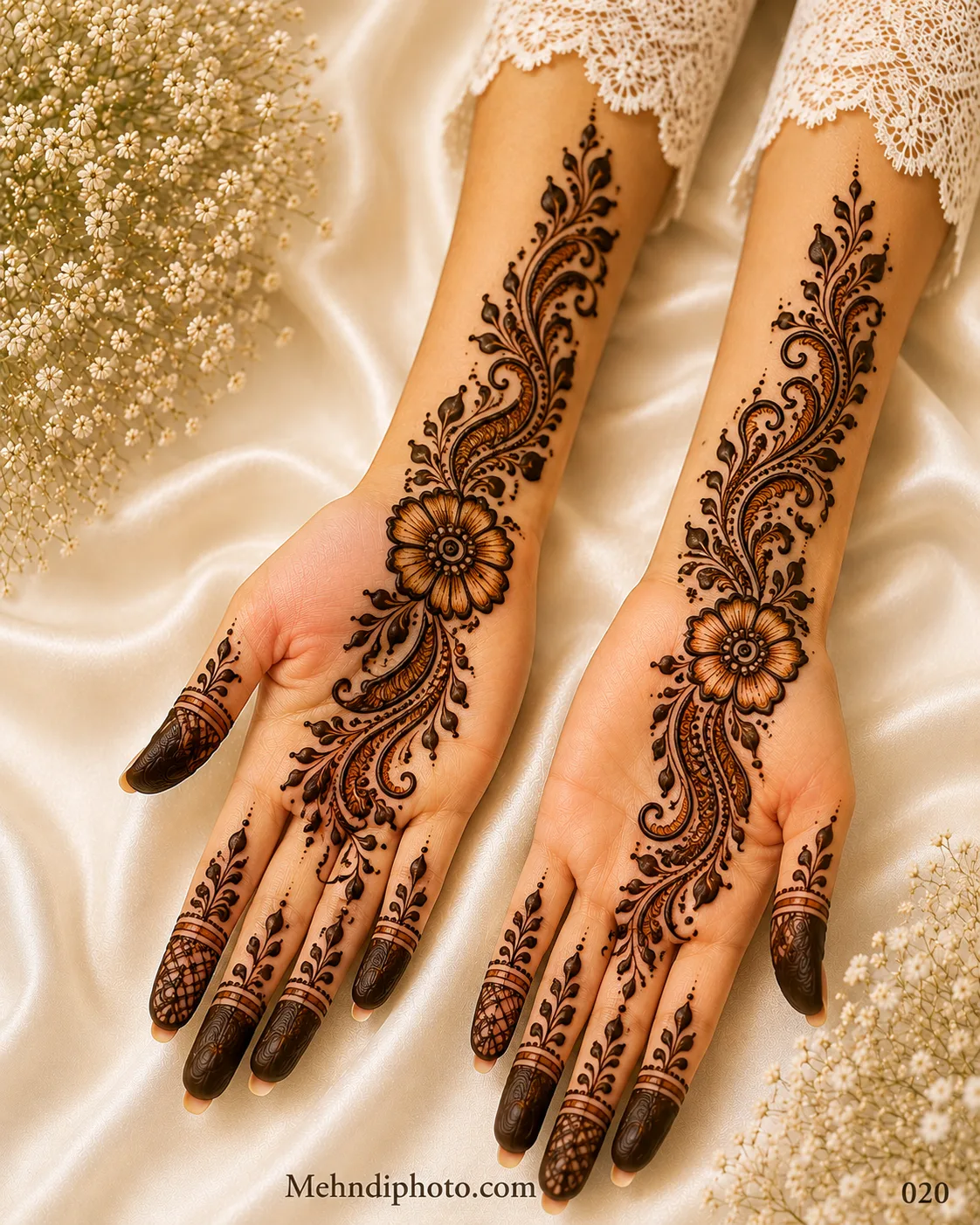
When people search for Muslim mehndi designs, they are usually looking for elegant henna ideas for Eid, Nikah, weddings, family functions or festive gatherings. There is not one single religiously defined “Muslim mehndi style.” In practice, the designs people choose are shaped by family traditions, region, fashion and personal preference. That is why you may see Arabic-inspired florals, Pakistani jaali work, Indian mandalas, minimal finger patterns and detailed bridal mehndi all grouped under the same search.
The most useful way to choose a design is not to worry about whether it fits one fixed label. Instead, look at the occasion, the outfit, the jewellery you plan to wear, how much coverage you want and how much time you have for application.
This guide brings those decisions together so you can choose a design that looks graceful in person and in photographs, whether you want a quick Eid pattern or a more detailed Nikah and bridal look.
What makes a Muslim mehndi design feel elegant?
Elegant mehndi usually has a clear visual structure. The eye can understand where the main motif is, how the pattern moves across the hand and where the design ends. A design does not need to cover every inch of skin to look complete.
Some of the most popular elements include:
- Floral vines and leafy trails
- Arabic-style open spacing
- Jaali and lattice patterns
- Mandala or gol tikki centres
- Jewellery-inspired finger and wrist bands
- Paisleys and curved borders
- Fine dots and scalloped edging
- Personal initials for Nikah or engagement functions
The important part is balance. If the fingers are highly detailed, the palm can be slightly more open. If the palm has a large focal flower or mandala, the fingers often look better with lighter supporting motifs.
Simple Muslim mehndi designs for Eid and family functions
For Eid, Chand Raat and smaller family gatherings, many people prefer designs that are quick to apply but still feel festive. A simple design can look polished when it uses one strong idea instead of many small unfinished details.
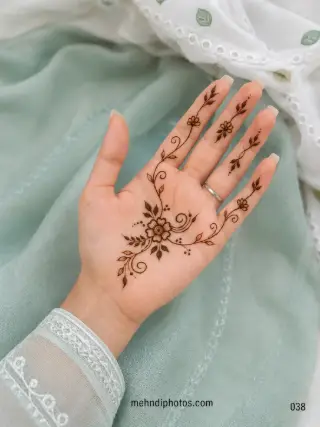
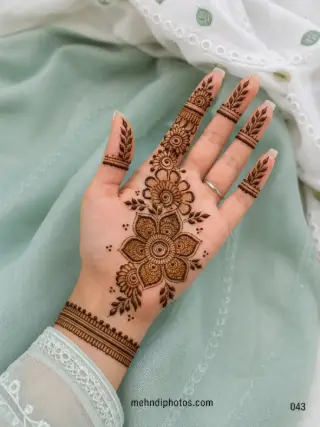
Diagonal floral trail
A diagonal trail beginning near the wrist and moving toward the index or middle finger is one of the easiest structures to wear. It leaves enough open skin to feel light while still creating a complete composition. Large flowers, leaves and a few dots usually work better than very fine filling.
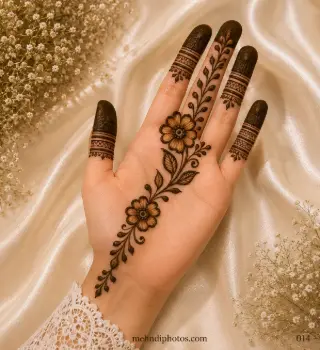
One-sided Arabic pattern
An Arabic-inspired pattern can run along one edge of the palm and continue toward one or two fingers. This style is especially useful when you want visible mehndi without full-hand coverage. You can compare similar flowing structures in the Arabic Mehndi collection.
Minimal back-hand jewellery style
On the back of the hand, a bracelet-like wrist band connected to the ring finger with a thin vine can look very elegant. This layout works well with rings because it keeps the centre of the hand relatively open.
Finger-only mehndi
If you are short on time, decorate only the fingers. Alternate between small bands, leaves, dots and tiny floral motifs instead of trying to make all five fingers identical. See the Finger Mehndi collection for ideas that work well in small spaces.
Eid mehndi: how much coverage is enough?
There is no correct amount of mehndi for Eid. Some people enjoy full palms, while others prefer a small design they can apply quickly the night before.
If you are applying mehndi at home or helping several family members, medium or light coverage is usually more practical. A good approach is to finish one area properly—the palm, back hand or fingers—rather than spreading small details across the whole hand.
For a clean Eid look, choose two or three of these elements:
- A floral centre or small mandala
- Two decorated fingers
- A light wrist border
- A leafy trail
- Open fingertips or simple fingertip filling
Keeping the number of elements limited makes the design easier to apply and easier to read in photos.
Nikah mehndi designs: graceful without looking too heavy
Nikah styling can range from very understated to fully bridal. If your outfit and jewellery are already detailed, medium-coverage mehndi can create better visual balance than filling the entire hand with fine work.
A useful Nikah layout is a fuller palm with a cleaner wrist and forearm. Another is a detailed back hand with jewellery-style chains and finger bands, leaving enough open skin around rings and bangles.
Initials and personalized details
Small initials can be included without turning the whole design into a portrait-style bridal composition. Place them inside a flower, small frame, paisley or near the wrist so they feel integrated rather than added at the last minute.
Ring-friendly placement
If you plan to wear an engagement or Nikah ring, look at the back of the hand before finalizing the pattern. Dense mehndi around the ring finger can compete with the jewellery. A thin finger band or open space around the ring often photographs better.
Matching both hands
Both hands do not need to be exact copies. They can use the same visual language—similar flowers, borders and spacing—while changing the internal details slightly. This usually looks more natural than forcing every motif to match perfectly.
Bridal Muslim mehndi designs
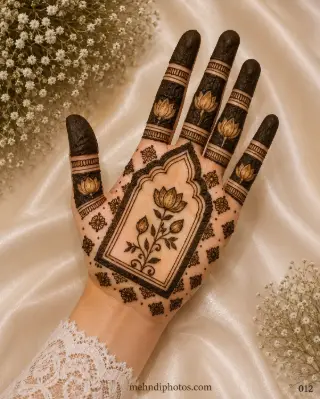
For brides who want fuller coverage, the design can extend from fingertips to the wrist or forearm. Traditional elements such as jaali, florals, paisleys, architectural borders and fine filler patterns can be combined without making the design visually flat.
The strongest bridal compositions usually have a hierarchy:
- One or two large focal motifs
- Medium-size supporting flowers or paisleys
- Smaller fillers only where needed
- Defined borders between sections
- Some breathing space so the major motifs remain visible
If you are comparing fuller wedding styles, browse the Bridal Mehndi collection. The goal is not simply maximum coverage. The goal is detail that still looks organized from a normal viewing distance.
Arabic-inspired Muslim mehndi designs
Arabic-inspired mehndi is popular because it uses bold motifs and negative space. Instead of filling every area, the pattern often travels in a clear direction across the hand.
Common features include large flowers, shaded leaves, curved paisleys and open sections. This style works especially well for Eid, parties and guests at wedding functions because it can look festive without needing several hours of application.
On the front hand, a floral trail can move from the wrist across the palm to the index finger. On the back hand, the same idea can be adapted into a lighter vine that works around rings and bracelets.
Pakistani-style details and jaali work
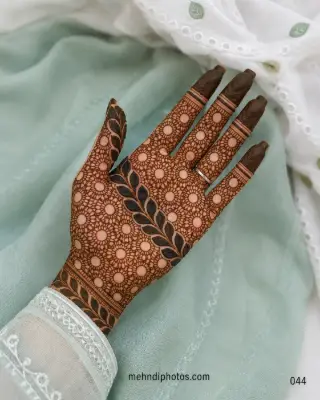
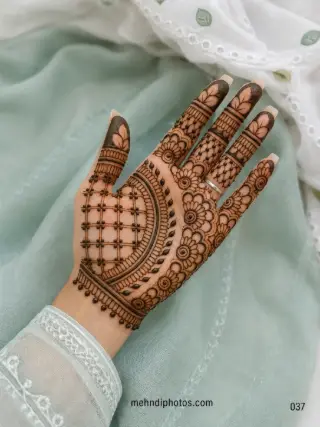
Many people searching for Muslim mehndi also like Pakistani-inspired patterns. These often combine floral details, geometric sections, jaali work, wrist cuffs and more structured finger designs.
Jaali can be beautiful, but it needs even spacing. If you are applying the design yourself, use jaali in one smaller section rather than across the entire hand. A small lattice panel surrounded by florals can give the same visual effect with less risk of uneven lines.
For bridal or formal looks, combine jaali with one bold motif so the design does not become a field of tiny repeated lines.
Front hand Muslim mehndi ideas
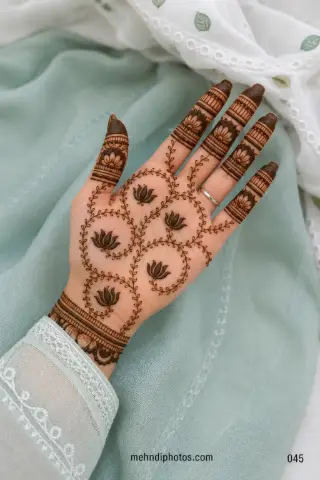
The palm is naturally suited to round and curved motifs because it has a broad centre. You can choose a mandala, flower or paisley as the main focal point and then decide how much of the fingers and wrist to connect.
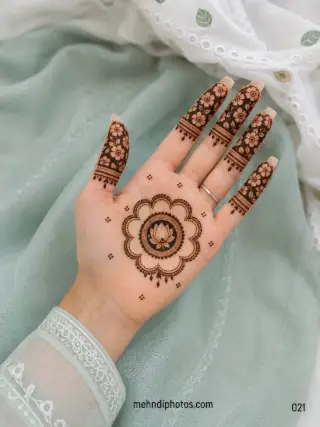
Central mandala with light fingers
A round mandala in the centre of the palm paired with simple finger bands creates a traditional but uncluttered look. If you like this structure, the Gol Tikki Mehndi collection is useful for comparing different centre sizes and finger pairings.
Asymmetrical floral palm
Instead of centring the design, place a flower slightly to one side and let the leaves travel diagonally. This is forgiving for self-application because it does not depend on exact symmetry.
Half-palm design
A half-palm pattern can cover the lower or side section of the hand while leaving the rest open. It works well for people who want a modern look or do not want mehndi touching every part of the palm.
Browse the Front Hand Mehndi collection to compare how different layouts use the centre of the palm.
Back hand Muslim mehndi ideas
The back hand is often more visible in photographs, especially when holding a clutch, adjusting a dupatta or showing jewellery. It is also a good place for minimal designs.
Bracelet and chain design
A wrist band connected to one finger can imitate hand jewellery. This looks especially elegant with bangles and rings because the mehndi becomes part of the accessory styling.
Floral finger bands
Small floral or leafy bands across two or three fingers can create a finished look without covering the entire back hand.
Long leafy vine
A thin vine moving from the wrist toward the middle or ring finger creates length and can visually slim the hand. Keep the vine slightly off-centre if you want room for a ring.
For more references, see the Back Hand Mehndi collection.
Finger patterns that work with Muslim mehndi styles
Finger mehndi can completely change the look of a design. Heavy fingers with a very light palm may feel unbalanced, while completely empty fingers can make a detailed palm look unfinished.
Reliable finger ideas include:
- One or two thin bands near the first joint
- Small leaves moving upward
- Half-flower motifs near the knuckles
- Dots arranged in a vertical trail
- Alternating filled and open fingertips
- Fine geometric sections on one accent finger
You do not need the same pattern on all five fingers. Coordination is usually more attractive than exact repetition.
Simple vs detailed: which design should you choose?
Choose a simple design when you have limited time, are applying mehndi yourself, want more visible skin or plan to wear prominent jewellery. Simple designs also tend to be easier to maintain while the paste dries because less of the hand is covered.
Choose a detailed design when the mehndi is an important part of the event styling, you have enough time for application and the outfit can visually support heavier hand detail.
If you are unsure, medium coverage is often the safest choice. One detailed section with open areas around it gives you the richness of bridal work without making the entire hand dense.
How to choose mehndi according to your outfit
Look at the embroidery scale on your clothes. If the outfit has tiny all-over work, copying equally tiny mehndi details can make the overall look too busy. A few larger florals can create contrast.
If your outfit is minimal, more intricate mehndi can become the visual focus. Jewellery also matters. Heavy rings and bangles usually look better when the design leaves small breathing spaces around them.
Colour does not require exact matching because mehndi develops its own brown-to-maroon stain. Instead of matching colour, repeat a shape or feeling from the outfit—a floral curve, scalloped border or geometric line.
How to choose a design for short or long fingers
Finger length changes how a pattern reads. On shorter fingers, too many horizontal bands can make the fingers appear visually shorter. Use fewer bands and include small vertical vines or leaf trails.
On longer fingers, you have more room for layered bands, geometric sections or repeated leaf motifs. Keep the scale consistent with the palm so the fingers do not look much more detailed than the rest of the design.
Common mistakes that make a design look crowded
Using a different motif in every empty space
Not every gap needs filling. Empty skin helps separate the main elements and makes the design easier to understand.
Making all details equally small
When every motif is tiny, the design loses hierarchy. Use a mix of large, medium and small elements.
Overdecorating every finger
If the palm is already detailed, keep at least some finger sections lighter. This creates contrast.
Ignoring jewellery placement
Plan for rings, watches and bangles before application. A beautiful motif hidden under jewellery does not help the final look.
Copying a reference without adjusting for the hand
A reference may have been created for a longer palm, wider wrist or different finger length. Keep the idea, but adjust the scale and number of motifs to the actual hand.
Quick Muslim mehndi ideas when you have only 10–20 minutes
If time is limited, choose one of these structures:
- A central flower with two decorated fingers
- A diagonal leafy trail
- A wrist bracelet connected to the ring finger
- A small gol tikki with fingertip details
- Three coordinated finger bands on the back hand
- One large Arabic flower with a few leaves
These are easier to complete cleanly than a full-hand pattern started in a hurry. For more beginner-friendly references, browse the Simple Mehndi collection.
Tips for cleaner mehndi application
- Start on clean, dry skin without lotion or oil.
- Test the cone flow before touching the hand.
- Draw the largest motif first so the scale is established early.
- Use connecting leaves and curves after the main shape is in place.
- Do the fingers after the palm or back-hand structure feels balanced.
- Keep the cone pressure steady instead of squeezing harder when a line breaks.
- Do not scrape the cone tip along the skin; let the paste fall in a controlled line.
If one line bends slightly, turn it into part of a leaf, curve or border rather than covering the area with extra detail.
Aftercare for a deeper stain
Stain depth depends on henna quality, skin chemistry, placement and aftercare. Fresh henna often appears orange after the paste comes off and becomes deeper over the following hours.
- Allow the paste to dry naturally.
- Keep it on for several hours when practical.
- Avoid washing the area immediately after removing dried paste.
- Try not to expose the fresh stain to repeated water contact too soon.
- Be patient—the final shade usually develops gradually.
Palms often stain more deeply than some areas on the back of the hand because of differences in the skin.
Muslim mehndi for brides, guests and family members
The same celebration can support very different levels of mehndi. A bride may choose full hand and forearm coverage. A sister or close family member may prefer medium coverage with jewellery-style back-hand work. Guests may choose a small Arabic flower or finger design.
Thinking in levels of coverage makes it easier to coordinate a family mehndi session without everyone wearing the same pattern.
Frequently asked questions
Is Muslim mehndi a separate religious style?
No single mehndi pattern is prescribed as a specific “Muslim style.” The term is commonly used online to describe henna ideas popular for Eid, Nikah, weddings and celebrations in Muslim families, often influenced by Arabic, Pakistani, Indian and regional traditions.
Which mehndi design is best for Eid?
For Eid, floral vines, Arabic-inspired trails, finger bands, simple mandalas and minimal back-hand designs are practical choices. The best one depends on how much time you have and how much coverage you enjoy wearing.
What type of mehndi works well for a Nikah?
Medium to full coverage with florals, jaali sections, jewellery-inspired details or personalized initials works well. Plan the back hand around rings and bracelets so the jewellery remains visible.
Can I use Arabic mehndi for a Muslim wedding?
Yes. Arabic-inspired designs are a popular aesthetic choice for weddings and festive events. You can keep them open and floral or combine them with denser bridal sections.
Should both hands have the same design?
They can match, but exact duplication is not necessary. Using similar motifs and coverage on both hands usually creates enough visual consistency.
Final thoughts
The best Muslim mehndi design is the one that fits your celebration, personal style and comfort. For Eid, a clean floral trail or finger pattern may be all you need. For a Nikah or wedding, you can build the design into a fuller composition with jaali, florals, paisleys and personalized details.
Do not judge a design only by how much skin it covers. Look at its spacing, direction, relationship with jewellery and whether the major motifs will remain visible in photographs.
Explore the Muslim Mehndi collection as new designs are added, and save references that match the level of coverage you actually want. A clear reference and a realistic plan usually produce a better result than choosing the most complicated design you can find.